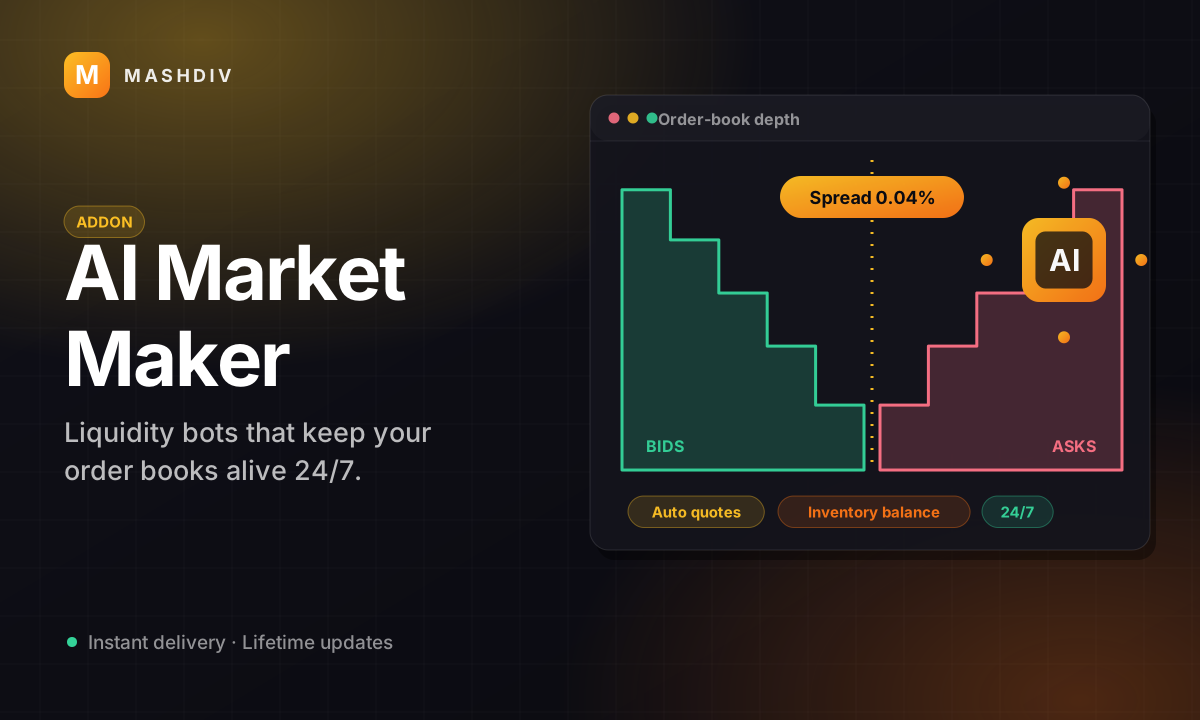
AI Market Maker
Give a brand-new Ecosystem pair a chart, a running tape and visible depth from the day you list it.
- A continuous price series on a pair that has never traded
- Thirteen candle intervals written by the engine, so the chart is never blank
- A live trade tape on your own Ecosystem market, printed against that price
- Ten book levels at 0.1%-0.5% either side, rewritten on every print
- Real Liquidity 0-100% — the dial that decides if a customer can fill anything
- A funded pool per market, with deposits, withdrawals and a drift report
- Six bots per market, each with its own size, spread and daily trade budget
- Target price, floor and ceiling: the price cannot leave the band you set
- Run autonomous, or tether to an external symbol through your spot exchange provider
- A dashboard that says whether a market is quoting, and names the closed gate
- Volatility and daily-loss auto-pause, a circuit breaker and a fleet-wide stop
- P&L measured only where a real customer was on the other side of the fill
Inside AI Market Maker
A new listing that already has a chart
A price engine, six bots and a funded pool, attached one-to-one to an Ecosystem market — so the pair you list today has a price series, a running tape and depth on both sides instead of an empty screen.
In detail
A newly listed Ecosystem pair is an empty screen: no chart, no last price, no tape, no depth. AI Market Maker is the admin-side engine that fills it. You attach one market maker to one Ecosystem market, fund its pool, press Start, and that pair publishes a continuous price series, prints a tape against it, writes all thirteen candle intervals the chart reads, and shows ten levels of depth around the touch.
How it works
A price engine advances the price against wall-clock time on every tick, inside a floor and ceiling you set and steered toward a target price you choose. Six bots decide when a print happens, how large it is and which of them takes each side — they never decide the price. Every print writes a trade row, rewrites the book levels at 0.1% to 0.5% either side, and updates the candles. Be clear about what that is: with **Real Liquidity at 0%**, the shipped default and the place to start, both sides of every print are the house. Nothing on that book can be filled and none of your money is at risk. Raise the dial and part of each print becomes a genuine resting LIMIT order in the Ecosystem book, backed by your pool — and that is when a customer can fill one.
What you configure, per market
| Surface | What you set |
|---|---|
| Price | target price, floor and ceiling, four Wyckoff phases, bullish or bearish bias |
| Volatility | base percentage, phase multiplier, momentum decay, auto-pause threshold |
| Price mode | autonomous, follow an external symbol, or hybrid at half that strength — the two tethered modes need an enabled platform exchange provider |
| Activity | aggression level, daily volume budget, six bots with six settings each |
| Money | pool deposits and withdrawals, real liquidity from 0 to 100% |
What operators control
Seven console screens behind fourteen permission keys. A dashboard that answers whether a market is actually quoting rather than what you last clicked, naming the closed gate when it is not. Per-market start, pause, stop, forced phase and daily-counter reset. Nine global settings, a book-wide daily loss limit with a circuit breaker, volatility and loss auto-pauses, and a fleet-wide emergency stop that records your written reason on every market it halts.
Requires Bicrypto core and the **Ecosystem** addon — the bots quote Ecosystem markets, settle through its matching engine, and every bot order, trade and candle lives in its ScyllaDB keyspace. And know the limits. This makes a market look alive and gives a chart something to draw; it does not make your book deep until you fund a pool and turn Real Liquidity up, and then your pool is the counterparty. Following an external symbol runs through the platform's shared spot exchange provider, so with no enabled provider — or a key the provider rejects — the tether never engages, the screen still reads Follow external, and nothing on the admin side reports the gap. A platform-only token has no external reference to follow at all.
One dial decides whether anything on that book can be filled
Real Liquidity is a share of every print, and it ships at zero. At zero the bots only trade each other: you get a price series, a tape and ten book levels written with a 120-second TTL that the matching engine cannot match against. That is a display, and it is the right place to start — no counterparty, no customer can fill anything, and none of your money is behind it. Raise the dial and part of each print becomes a genuine resting LIMIT order in the Ecosystem book, backed by the pool you funded.
Above zero, a customer filling a bot order is trading against your pool balance in the same transaction that pays them — there is no house account and no netting. Run at 0% for a day first, fund both sides, then raise it in steps. Pool withdrawals and rebalancing both refuse an ACTIVE market, so pause before you touch the money.
ACTIVE is what you last clicked. Quoting is what the engine is doing
Four gates are checked on every tick, and a market that fails one keeps its ACTIVE badge while printing nothing. Two active bots minimum, because a print needs two sides. A funded pool, once real liquidity is above zero. The daily volume budget, which is volume today and never a rolling day. And measured volatility against the market's own threshold. The console evaluates the first three against the same rows the engine reads and names the closed gate on the row, so it states the remedy rather than the symptom.
The volatility gate is measured from price history held in the engine's memory, which no query can reach — so the dashboard reports it as not visible rather than claiming a market passes a gate it cannot see. The reason is in the server log.
The price is yours to steer, and it cannot leave the band
One process drives each market's price across seven timescales, from twenty minutes to about three years, and it advances against wall-clock time whether or not a trade prints — so a gated market or a restarted server resumes mid-trajectory instead of flatlining. You set the target it steers toward and the floor and ceiling that contain it, at most 50% either side. Four Wyckoff phases run on their own or can be forced, bias and volatility are dials, and a market can run autonomously or tether to an external symbol at a strength you choose — hybrid is that same tether at half strength, not a third mechanism.
Containment only engages in the outer fifth of the band, and while it is pulling, the direction of the next move becomes progressively predictable. Keep the range wide enough for the volatility you configured, and use AUTONOMOUS on any market that also settles binary options — a tethered market is readable from the feed it tracks. The tether itself runs through the platform's shared spot exchange provider: with none enabled it simply never engages, silently, while the screen still reads Follow external.
Six bots per market, and every dial on each of them is yours
A new market maker is seeded with six bots — two scalpers, a swing trader, an accumulator, a distributor and a market maker — carrying five personalities between them. A personality is a lean, not a strategy: it decides which bot is more often found on the bid and how large it trades, never which way the price goes. Each bot then carries six settings you can change: risk tolerance, trade frequency, average order size, size variance, the spread it quotes real liquidity at, and a daily trade budget. Only the fields you actually changed are recorded, and the change reaches the running market immediately rather than at the next reload.
The daily budget is a budget rather than a fuse — it is paced across a twenty-four-hour activity curve, so a bot spends its allowance over the whole day instead of exhausting it before lunch. A bot can also be put into cooldown, which expires on its own; that expiry only runs on markets that are still active, so it can never lift a pause you applied.
What the pool earned, and which record each figure came from
Only fills against real users produce a profit or a loss. Every one of them is written to a per-fill ledger carrying the side, the price, the amount, the fee, whether the bot was the resting side and the realised P&L, and the daily, weekly and monthly figures are summed from that ledger. All-time comes from a separate lifetime accumulator on the bot rows that predates it, and the screen says which figure came from which, so three small period numbers beside a large all-time one do not read as a collapse. Return on investment is measured against the capital basis — what you have put into that pool and not taken back out, with the base side valued at the target price — and sits beside what the pool is worth now.
A period with nothing behind it reads as an em dash rather than a zero, because a zero that means not measured must not look like a zero that means broke even. Bot orders are placed fee-free, so the fees figure is 0 by construction; the P&L subtracts it anyway, so the number stays right if that ever changes.
A market that starts losing pauses itself, and the row says why
A risk monitor reads every market that is not stopped, every ten seconds, and measures the day's realised loss against that market's own pool value. Past the book-wide limit — one setting, 0–25%, which falls back to 5% until you save it — the market goes from ACTIVE to PAUSED by itself, every active bot on it is paused with it, and an AUTO_PAUSE row is written naming the cause and the percentage. The same pass auto-pauses on volatility against the market's own threshold or the global default, warns on a pool that has been pushed to one side, and flags a market that has gone an hour since its last print without pausing anything. Per-trade rows age out on a retention window you set; lifecycle rows never do, so the record of why a market stopped outlives the trades that caused it.
Only a daily-loss pause lifts itself, and only once it belongs to an earlier UTC day. A volatility pause waits for you, and a pause you applied yourself is never undone by either path. The fleet-wide emergency stop is the manual layer: it will not fire without a written reason, records that reason on every market it halts, turns the global switch off and leaves everything down until you start it again by hand.
- bots seeded per market
- 6
- book levels per print
- 10
- candle intervals written
- 13
- console screens
- 7
Everything included
107 capabilities, in 10 areas
Every item below exists in the source you receive. Nothing here is a roadmap.
Setting a market up
One market maker, attached to one Ecosystem market.
- Four-step create wizard: pick the market, price, trading, review
- One market maker per Ecosystem market, enforced by a unique index
- Created stopped, with an empty pool and six paused bots, in one transaction
- Target price pre-filled from the Ecosystem market's own price
- Range entered as a percentage either side, stored as a floor and a ceiling
- Refusals for a target outside the range, a deviation over 50%, or a price under 0.00000001
- Aggression level — conservative, moderate or aggressive — which seeds the bots
- Daily volume budget, enforced as a hard trade gate rather than a target
- Every core field editable afterwards, with only the changed ones recorded
- Delete that stops the market, cancels its orders, returns the pool and cascades the rest
The price engine
The one thing allowed to decide the price.
- Seven mean-reversion horizons, from twenty minutes to about three years
- Price advanced against wall-clock time, not against tick count
- Engine state checkpointed roughly every two minutes, so a restart resumes mid-trajectory
- A secret per-market entropy seed, stripped from every API and WebSocket response
- Four Wyckoff phases: accumulation, markup, distribution, markdown
- Six multi-month narrative archetypes behind the phase schedule
- Forced-phase control that bypasses the normal transition rules and expires
- Directional bias — bullish, bearish or neutral — with a 0–100 strength
- Base volatility, phase multiplier and momentum decay as separate dials
- Momentum events: surge, dump, spike and flash crash
- Containment inside your floor and ceiling, engaging in the outer 20%
- A geometric band reading, so a 1-to-100 range centres at 10
Following an outside price
Optional. Autonomous is the default and the safer one.
- Three price modes: autonomous, follow external, hybrid
- Hybrid is the same tether at half the configured strength
- Correlation strength 0–100, sized as convergence time rather than as a peg
- Restoring drift capped at three daily volatilities per day
- Reference price read through the platform's shared spot exchange provider
- A cached reference refreshed beside the tick, so a slow exchange cannot stall a market
- Price-sync pass every 30 seconds, warning past 10% drift from the target price
- Deviation alerts written into history, throttled to one per market per hour
The bots
They decide when a print happens and who takes each side. Never the price.
- Six seeded per market: two scalpers, a swing trader, an accumulator, a distributor and a market maker
- Five personalities, each with its own buy affinity, size multiplier and minimum gap
- Per-bot risk tolerance, trade frequency, average order size and size variance
- Per-bot preferred spread — where that bot quotes real liquidity
- Per-bot daily trade budget, paced across a 24-hour activity curve
- Order sizes from a realistic distribution, snapped to round lots
- Statuses active, paused and cooldown, with a cooldown that expires on its own
- A two-active-bot minimum, checked before the bot layer is consulted at all
- Per-bot record: real fills, profitable fills, realised P&L, position and average entry
- Bot edits that reach the running market immediately, not at the next reload
What your customers see
The tape, the book and the chart on an ordinary Ecosystem trading screen.
- Ten synthetic book levels per print, at 0.1% to 0.5% either side
- Levels sized at 50–150% of the trade amount, written on a 120-second TTL
- Only the engine's own TTL-bearing levels are cleared, so a customer's resting order survives
- Thirteen candle intervals written on every print, from 1m to 1w
- A ten-second price heartbeat on gated ticks, carrying zero volume, so the chart stays continuous
- A trade tape written into the same Ecosystem table a genuine fill writes to
- Last price, 24h change and 24h volume derived from the engine's own daily candle
- A close published by the Binary AI Engine pinned for that minute, across threads and processes
- Chart history that survives a stop, a restart and a deploy
Real liquidity and the pool
The dial that decides whether anything on that book can be filled.
- Real Liquidity 0–100%: the share of each print placed as a genuine resting limit order
- Resting orders priced from the bot's own spread, widened for measured volatility
- A one-hour expiry per real order, and a 500-order resting ceiling per market
- Bot orders carry a zero fee and lock no wallet — the pool backs them
- A two-sided pool per market, funded from an admin's own ecosystem wallet
- Deposits and withdrawals, with an optional idempotency key for a retried submit
- A capital basis that accumulates over every deposit and withdrawal
- TVL, realised and unrealised P&L, per pool
- Fills that settle against the pool in the same locked transaction that pays the customer
- A fill that would overdraw either pool side refused outright rather than overdrawn
- Rebalance in report mode, or execute mode with a slippage cap
- Withdrawal and rebalance both refused while a market is active
The console
Seven screens, built around whether a market is actually quoting.
- Dashboard, markets, market detail, create, analytics, settings and an in-app guide
- Market detail with Overview, Pool, Bots and Configuration tabs
- A quoting meter with five states that add up to the active count
- A not-quoting row that names the closed gate rather than the symptom
- A price-against-band meter per market, stated in words as well as in position
- Inventory skew: base share held against base share funded, both at the current price
- Volume today against the sum of every market's daily budget
- A masthead naming the engine process, its leadership and what arbitrated it
- Alerts for silent markets by cause, and for an engine holding fewer markets than are active
- A 30-second refresh that pauses on a hidden tab and keeps the last good figures on a failure
- Lifecycle actions with server-enforced transitions: start, pause, resume, stop
- Guide sections for getting started, bot types, configuration, best practice, troubleshooting and an FAQ
Analytics and the record
- Performance over 1h, 24h, 7d or 30d, with price and volume history
- Measured target-achievement rate, TVL and both P&L figures
- Bounded reads that report when they truncated the window
- P&L daily, weekly, monthly and all-time, realised and unrealised
- ROI against the capital basis, with winning and losing fills and maker/taker counts
- A ledger note saying which table the period figures come from and when it begins
- Trade history filterable by date range and by bot, filtered before paging
- An immutable per-market trail across fifteen action types
- A daily summary written per market per UTC day
- Retention that prunes prints and deviation alerts, and never lifecycle rows
- A WebSocket snapshot plus seven event types, including live bot activity
Brakes
Five layers between a misconfigured market and a bad day.
- Four hard trade gates checked on every tick, before the bot layer runs
- Volatility auto-pause against the market's own threshold, or the global default
- Daily-loss auto-pause per market, measured against its own TVL
- An inactivity alert after an hour without a print, which pauses nothing
- A self-pause after twenty consecutive failed ticks, lifting on a doubling cooldown
- A book-wide circuit breaker with a 30-minute auto-reset and a UTC midnight clear
- A breaker reset that reports whether the engine was running and whether it was tripped
- A per-trade risk assessment that scales trade size down with measured volatility
- A fleet-wide emergency stop that records your written reason on every market it halts
- Auto-resume that reads recent history and never undoes a pause an operator applied
Settings and operations
- Nine global settings over four tabs: trading, bots, risk, emergency
- A master trading switch, a global pause and a maintenance mode
- All three suppress trades without freezing the price or flattening the chart
- Minimum quote liquidity a pool must hold before its market may start
- Book-wide maximum daily loss, 0–25%
- A default volatility threshold, and the automatic stop-loss switch
- A concurrent-market ceiling, 1–500
- Trade history retention, 0–3650 days
- A resting-real-order ceiling for every market at once, by environment variable
- Seven cron jobs under one category, visible in the platform's cron monitor
- Engine leadership arbitrated by a Redis key and a database lease row
- Fourteen permission keys, scoped per resource
- A stranded-order survey and cleanup command, dry-run by default
- Licence
- Addon licence, activated in the admin panel against your purchase code. Product id 61007981.
- Requires
- Bicrypto core and the Ecosystem addon, each licensed separately. The bots quote Ecosystem markets and settle through its matching engine.
- Runs on
- Your own server, inside the Bicrypto tree. No separate installer, no service of its own, no hosted tier.
- Data stores
- MySQL for the configuration, the money and the audit trail. ScyllaDB, in the Ecosystem keyspace, for orders, the tape, price history and the per-fill P&L ledger. Redis for engine leadership.
- Processes
- None of its own. Seven cron jobs register under one category, and the engine ticks once a second in whichever process holds the Ecosystem matching lease.
- Admin surface
- 7 admin screens, 28 REST endpoints and 1 WebSocket channel
- Access control
- 14 permission keys, scoped per resource: markets, bots, pool, analytics, settings, emergency
- Per market
- 6 bots, 1 two-sided pool, 13 candle intervals, 10 synthetic book levels per print
- Global settings
- 9, over four tabs, plus one environment variable for the resting-order ceiling
- Integrates with
- Ecosystem markets, wallets and matching engine; the platform's spot exchange provider, for external price tethering; the Binary AI Engine, whose settlement close it yields to
- No customer-facing surface
- Everything is admin-side. There is no user screen, no per-user setting and nothing a customer subscribes to — what customers see is the ordinary Ecosystem trading screen.
- At 0% real liquidity, nothing is fillable
- The shipped default writes a price series, a tape and ten display levels the matching engine cannot match against. It is a display until you fund a pool and raise the dial.
- Above 0%, your pool is the counterparty
- There is no house account and no netting. A customer's fill moves your pool balance in the same transaction that pays them, and an underfunded pool shows up as fills that fail.
- Bot-to-bot prints have no P&L
- Both sides are the house. Only fills against real users produce a profit or loss, and the screens show nothing rather than a number where there is nothing to measure.
- The tether needs an exchange provider
- Follow-external and hybrid read the price through the platform's shared spot exchange provider. With none enabled the tether never engages, silently, while the screen still reads Follow external — and a platform-only token has no external reference to follow at all.
- ScyllaDB backups are yours
- Every chart, trade, order record and per-fill P&L figure lives in Scylla, and the platform's MySQL backup does not cover it. Snapshot the keyspace on the same schedule as your database dump.
- It does not make your book deep
- A synthetic tape and ten display levels make a market look alive and give a chart something to draw. Real depth is the pool you fund and the percentage you set.
Loved by customers
Reviews
No reviews yet. Own it? Share your experience.
Own this product? Sign in to leave a review.
Better together
Bundles containing this product
Get AI Market Maker for less as part of a bundle.
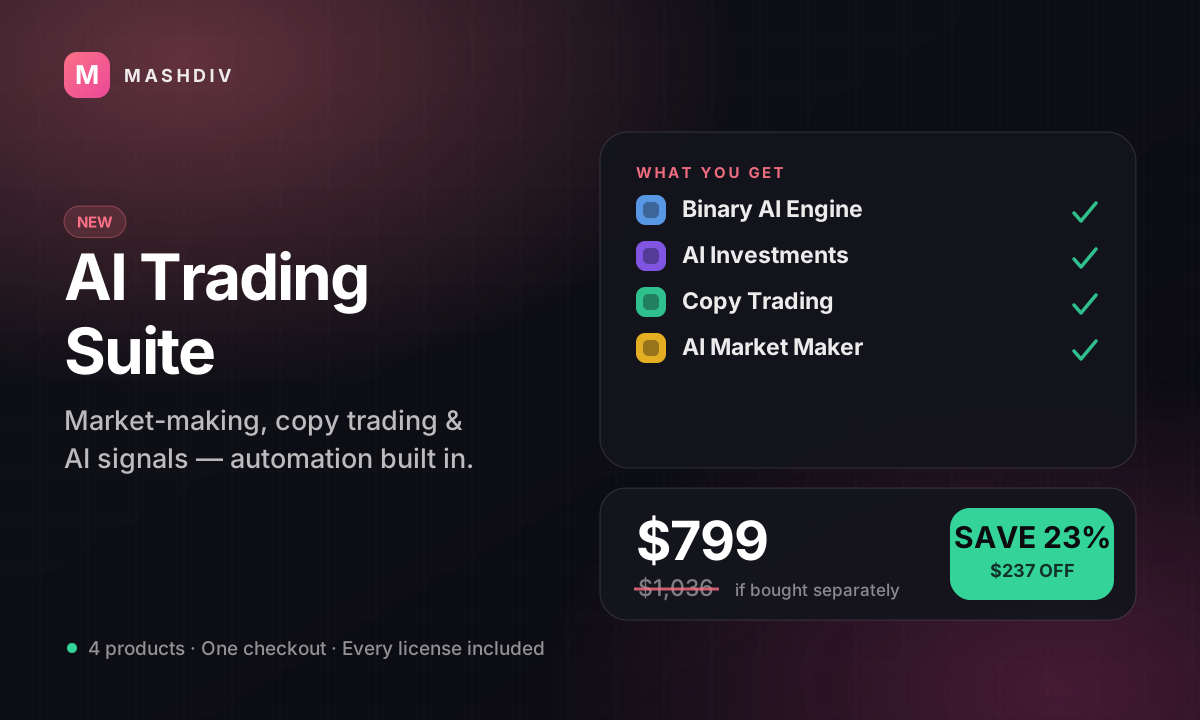
 NEW
NEWAI Trading Suite
Every AI-powered edge on Bicrypto — market making, signals, and copy trading in one suite.
- Binary Trading AI Engine for Bicrypto
- AI Investments for Bicrypto
- Copy Trading for Bicrypto
- AI Market Maker

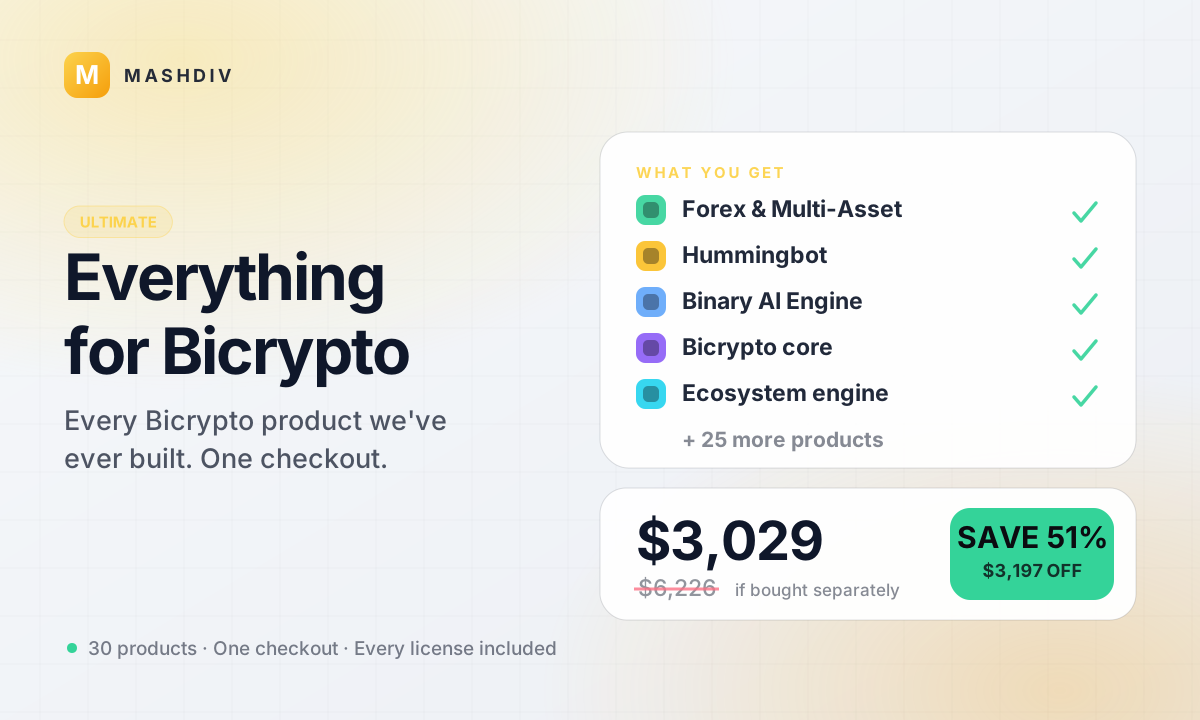 ULTIMATE
Everything for Bicrypto
Every Bicrypto product we make — every addon, every chain, both apps, one price.
- Forex & Multi-Asset Trading
- Hummingbot Connector
- Binary Trading AI Engine for Bicrypto
- Bicrypto
- + 27 more
Keep exploring
Related products
 Addon
AddonAI Investments for Bicrypto
A duration-based investment product where you set the term, the rate and the outcome — and fund it yourself.
 Addon
AddonForex Investment for Bicrypto
Run a managed forex desk: you set the plan, the term and the payout, and settlement runs itself hourly.

 Addon
AddonMLM & Affiliate System
Your members bring the next ones, and you pay commission only when a referral actually deposits or trades.