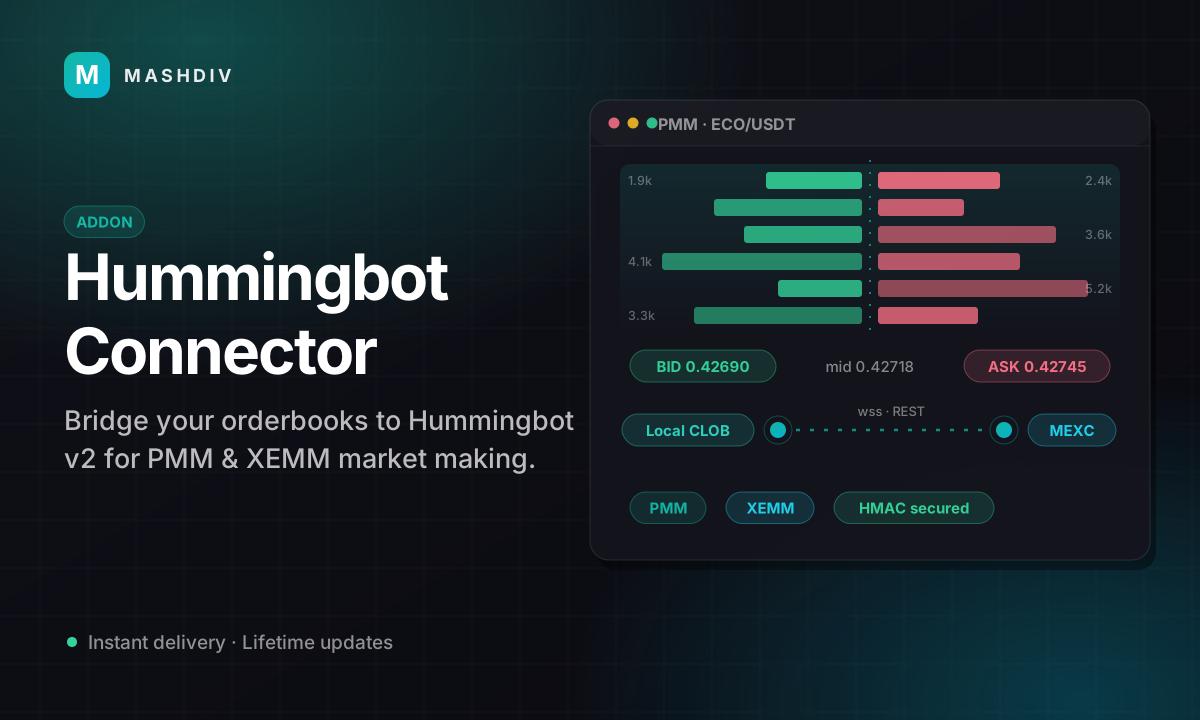
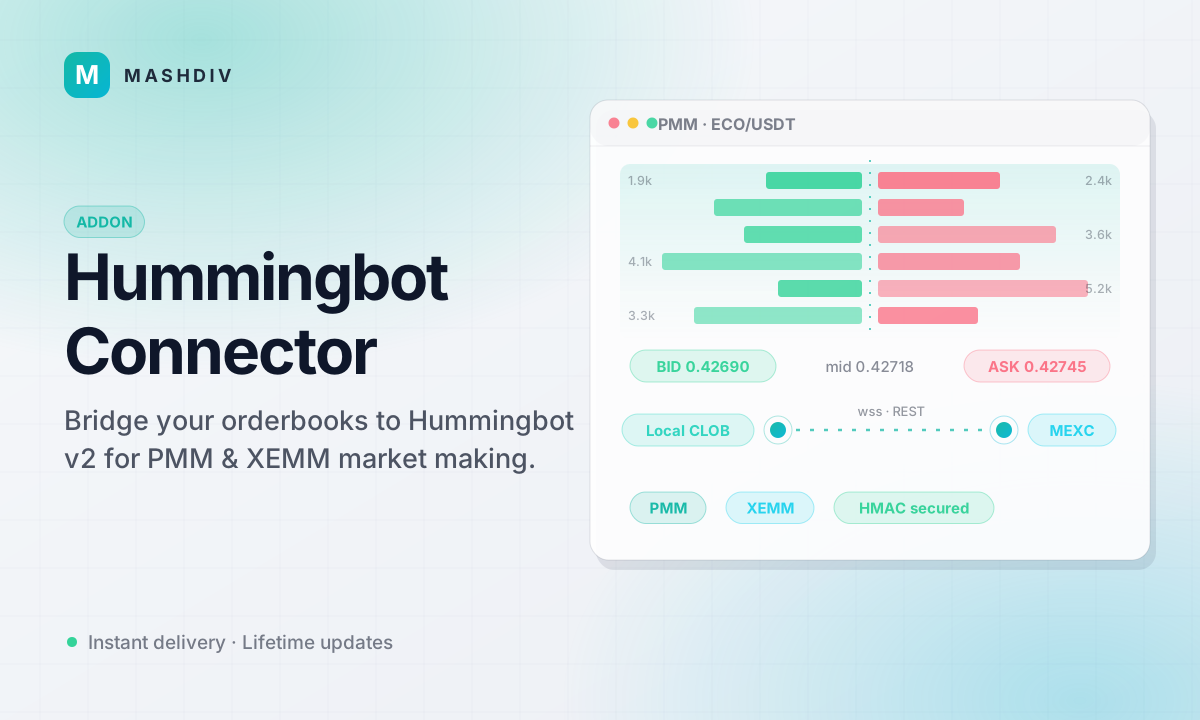
Hummingbot Connector
Make your platform a venue Hummingbot can trade on — and keep the kill switch in your admin panel.
This is a new release, so the first 50 customers get it below its normal price of $349. No code needed — the price you see is the price you pay. When the seats are gone the price goes back up.
- 10 seats at $16910 left
- 20 seats at $219−37%
- 20 seats at $259−26%
You save $180 at today's price. Every licence bought at launch is a full licence — same product, same updates, same support terms as it will have at $349.
- A Binance-shaped REST surface, so Hummingbot's stock parsers need no changes
- HMAC-signed requests with single-use nonces — a key string alone proves nothing
- 8 scopes in 5 presets, and none of them withdraw, so a leaked key cannot drain
- IP allowlist and expiry per key, so a stolen secret is useless from anywhere else
- One multiplexed WebSocket: books, trades, mark price, funding, orders and fills
- Spot lands in the Ecosystem engine and perps in Futures — your book, your wallets
- Six strategy presets, published, so nobody guesses a spread ladder on day one
- A bot console that reads back your own rows — no bot hosting, no extra storage
- Global kill switch and read-only mode, one for an emergency and one for upkeep
- Per-account cancel-all and flatten, so one runaway bot is one click to stop
- Server-run market makers started, stopped and diagnosed from the browser
- Per-key rate-limit overrides, to throttle one bot without slowing everyone else
Inside Hummingbot Connector
Your platform becomes a venue a bot can trade on
An off-the-shelf market maker connects to your exchange with a signed API key and starts quoting — and every order it places is an ordinary row on your own book. It is a bridge, not an engine: spot flow goes to the Ecosystem matching engine and perpetual flow to Futures, so nothing about your custody, your ledger or your fees changes.
In detail
Your exchange becomes a venue an off-the-shelf market maker can trade on. A customer drops a connector package into their own Hummingbot, mints a signed API key on your site, and their bot starts quoting your pairs — and every order it places is an ordinary row on your own book, settling through your own wallets. You can run market makers of your own too, supervised from the admin panel, so a new listing does not launch with an empty book.
How it works
It is a bridge, not an engine: this addon owns no order book. Spot orders are forwarded to the Ecosystem matching engine and perpetual orders to the Futures engine, so fees, custody and settlement are unchanged. Bots talk to a Binance-shaped REST surface at /api/hb plus one multiplexed WebSocket, and every bot-facing call is signed — HMAC-SHA256 over the method, path, timestamp, single-use nonce and body. That signature is verified before expiry, disabled state, clock drift or IP, so knowing a public key string tells an attacker nothing.
The surface you configure
| Surface | What ships | Yours to set |
|---|---|---|
| Key scopes | 8 scopes in 5 presets | the bundle a key gets, IP lock, expiry |
| Rate limits | trade 600/60s, data 1200/60s, account 240/60s | per-bucket defaults, plus an override on one key |
| Strategy presets | 6 published — 4 market making, 2 cross-exchange | spread ladder, sizes, refresh, risk barriers |
| Global controls | kill switch and read-only mode, both off | when to throw either one |
| Server-run bots | supervised instances, 1536 MB cap each | market, preset, key, memory ceiling, auto-restart |
What operators control
Seventeen permission keys split five admin screens, so a support role can read the key registry without reaching the kill switch. The registry carries every Hummingbot-capable key with its scopes, expiry, disable reason and audit trail. The Command Center lists every account running a bot and gives you force cancel-all and flatten per account. Bot Instances registers a Hummingbot checkout on your own server, diagnoses it against nine checks, then starts, stops and streams its logs to the browser.
Two hard dependencies: Bicrypto core, and the Ecosystem addon — that is the book spot orders route to. Add Futures only if you want perpetuals; without it the perpetual paths return a clean 503 and everything spot keeps working. Redis is required for nonce replay protection. And Bot Instances is for your own market making, not hosting for users: one bot costs 400–700 MB, about 1.2 GB for cross-exchange making, on the same host as your database.
A credential that can trade and can never withdraw
Bots authenticate with an HMAC-SHA256 signature over the method, path, timestamp, single-use nonce and body — not a session token. Eight scopes ship in five presets, and not one of them moves money off the platform, so the worst a leaked secret can do is trade badly. Keys can be locked to an IP, given an expiry, disabled from either side and rotated; the signing secret is shown once and no administrator can read it afterwards.
The signature is checked before expiry, disabled state, clock and IP, so knowing a public key string tells an attacker nothing. Requests more than ten seconds from your server's clock are refused — a drifted clock on the bot's host is the most common failure this product has. Nonce replay protection needs Redis.
Every channel a market maker needs, on one socket
A single WebSocket carries eleven channels: seven public ones — the spot book, trades, ticker, the perpetual book, mark price and funding rate among them — and four private ones for a customer's own orders, balances, positions and fills. The public seven need no key. The private four need a signed handshake sent in-band on the same connection, checked by the same HMAC path the REST routes use, and until it arrives the subscription is refused outright: the topic comes back in the acknowledgement's rejected list instead of being accepted and then sitting silently empty. Once a socket signs it is bound to one verified account and no other connection can be handed its data. Fills arrive as their own events, derived server-side from the executed amount, carrying an id that dedupes against the same fill fetched over REST.
The server publishes on a timer rather than hooking into the matching engine: the book ticks every 200 ms by default, trades every 500, the ticker every second, and every interval is set per deployment. There is no diff channel — the depth channel sends the same full snapshot the book channel does. A refused topic is not queued behind the handshake either — the bot signs, then subscribes again. One connection takes 200 subscriptions and 20 client messages a second.
Stop one bot, or every bot, from the admin panel
A Command Center lists every account running a bot with its live orders and positions, and gives you force cancel-all and flatten per account. Two global switches sit above it: a kill switch that refuses every signed request, and a read-only mode that blocks placement and cancellation while market data and balances keep working. Each key also carries its own disable, rate-limit override and audit trail.
Disable the key first, then cancel — a market maker re-quotes within seconds of losing its orders. Both switches ship off and both fail open, so a settings or cache outage can never halt your exchange by accident.
Run your own market makers, without a terminal
Bot Instances registers a Hummingbot checkout on your own server and supervises it: start, stop, restart, reinstall the connector, diagnose it against nine environment checks and read its logs in the browser. Buttons record intent and one reconciler converges the process, so a double-click is harmless and a bot you asked to run comes back after a deploy. Six strategy presets — four pure market making, two cross-exchange — are seeded published so nobody guesses a spread ladder on day one.
This is for your own liquidity, not hosting for users. One bot costs roughly 400–700 MB, and about 1.2 GB for cross-exchange making, on the same host as your database. The memory watchdog is enforced on Linux only.
- endpoints a bot can call
- 23
- scopes, none for withdrawal
- 8
- strategy presets, published
- 6
- admin permission keys
- 17
Everything included
91 capabilities, in 8 areas
Every item below exists in the source you receive. Nothing here is a roadmap.
The connector your customers install
Hummingbot has no idea your exchange exists until this package is inside its own checkout.
- A spot connector package for Hummingbot v2, named so `connect bicrypto` finds it
- A separate perpetual connector package for derivative trading
- A market-making controller module that ships with both
- An installer that copies both packages, patches setup.py and proves the import
- Installer modes: read-only audit, clean reinstall, and force over a broken copy
- A local agent script that carries its own message broker and needs nothing installed
- The whole kit downloaded as one zip, identical for everyone and carrying no credentials
Signed API keys
The credential a bot trades on, and every dial on it.
- HMAC-SHA256 signature over the method, path, timestamp, nonce and body
- Single-use nonces, replay-checked and held for twice the receive window
- A ten-second receive window, the refusal naming the drift and its direction
- Eight scopes, splitting account reads, market reads, spot, perpetual and bot control
- Five scope presets on the key form: read-only, spot, perpetual, bot control, full
- No scope that can withdraw or move funds off the platform
- Per-key IP allowlist that denies by default when the list is empty
- Optional expiry, set in days at creation
- The signing secret shown once and excluded from every later response
- Secret rotation that invalidates the old one immediately
- Disable and re-enable, from the customer's side and from yours, stamped differently
- A per-key audit trail: creation, rotation, scope changes and every rejection
- A per-user key cap, and an optional verification requirement on create and rotate
The exchange a bot sees
A Binance-shaped REST surface, so an off-the-shelf bot's stock parsers need no changes.
- Exchange info with price, lot-size and minimum-notional filters and real precision
- Public liveness, server time, 24h ticker, order book snapshot and recent trades
- A separate perpetual feed: contract info, order book and the current funding rate
- LIMIT and MARKET orders on both desks, with your own client order id
- Order list, single lookup, amend, cancel and batch cancel
- Perpetual orders that can carry a stop-loss and a take-profit price
- Per-symbol leverage, refused by naming the leverages the market actually offers
- Open positions, and account balances across the funding and futures wallets
- Real HTTP status codes and a machine-readable error envelope, so a bot can parse a refusal
- Three rate-limit buckets — trade, market data, account — billed per key
- Budget headers on every response, and a retry hint on every refusal
The live data feed
One socket, multiplexed, public and private on the same connection.
- Eleven streams a bot subscribes to by name
- Spot order book, public trades and ticker, each on its own channel
- Perpetual order book, mark price and funding rate as their own channels
- Private order, balance, position and trade streams behind an in-band signed handshake
- Fill detection derived server-side, at a cadence you set without a restart
- Both common keepalive conventions answered
Strategy presets
A preset is a row, not a file — the YAML is generated from it on demand.
- Two controller families: pure market making, and cross-exchange market making
- Six presets seeded and published on install, so the catalogue is never empty
- Spread ladder, per-level allocation, refresh cadence and cooldown
- Triple-barrier stop loss, take profit and time limit
- Leverage per preset for perpetual market making
- Cross-exchange hedge venue, per-level profitability targets and a re-quote band
- Draft and published states, with the version bumped on every save
- YAML preview and download, printing the exact two filenames to save it under
- Validation on save and again on export, so a stored preset can never emit broken YAML
- A published catalogue your customers download for their own bots
Your own market makers, on your server
Register a Hummingbot checkout once, then never open a terminal again.
- Register an install by its checkout path and its own interpreter
- A detection pass over a bounded set of host locations, each offered with a confidence
- Provision a location: validate a path, create it, or clone the Hummingbot source into it
- A nine-check diagnostic that tests the real server and reports pass, warn or fail
- Start, stop and restart recorded as intent and converged by a single supervisor
- Five instance states: stopped, starting, running, stopping, crashed
- A graceful stop that gives the bot twenty seconds to pull its resting quotes
- Auto-restart with backoff, reset by a stretch of healthy uptime
- A memory ceiling per instance, so a runaway bot dies before your database does
- A host memory panel showing committed, free and total, read from the real machine
- A full-page bot terminal per instance: quote ladder, fill tape and the process log
- Crash cards that name a probable cause and the next action, not an exit code
- Re-adoption of a bot that outlived a backend restart, verified before it is adopted
- Reinstall the connector into a checkout from the browser, refused while it is running
- The Hummingbot config password encrypted at rest and handed over by environment
- A market preflight against the real market list, at registration and again at start
- Mint a scoped trading key for one instance from its own form, never returned to the browser
- Linux subsystem and running virtual-machine guests listed on a Windows host, so you provision where it can build
Oversight and emergency control
The screens you open when something is going wrong.
- A registry of every Hummingbot-capable key on the platform, with scopes and expiry
- A posture band splitting enabled from disabled, click-to-filter
- Fleet flags: expired but enabled, throttled, no secret, 24h failures, used in 24h
- Disable any key with a reason that is returned verbatim to the bot
- Bulk disable, with a confirmed count and per-key failures reported rather than rolled back
- A per-key rate-limit override on any of the three buckets, and a way to clear it
- A global kill switch that refuses every signed request
- A read-only mode that blocks placement and cancellation while reads keep working
- Both switches fail open, so a cache outage can never halt your exchange by accident
- A Command Center listing every account currently running a bot
- Drill into one account's live orders and open positions
- Force cancel-all for one account, spot and perpetual together
- Flatten: cancel the orders and close every open position
- Seventeen permission keys, so a support role can read the registry without the kill switch
What a customer gets
A read-back of rows you were already storing — no bot hosting, no extra storage.
- A live bot console showing resting quotes with age and distance from the touch
- A fill tape deduplicated by order id and cumulative amount, so a replay cannot double-count
- Inventory skew and open perpetual positions
- The book spread and the customer's own quoted spread, side by side
- A per-market rail when one account quotes more than one pair
- Five-minute fill count, traded volume and notional still resting on the book
- A health verdict with the remedy attached
- Five link states, including the one that matters: authenticated once, silent since
- An emergency stop that disables keys first and only then cancels
- A setup page that computes the outstanding step from the account's real keys
- A control tab and a bot log tab once the optional local agent is connected
- Eight agent commands, enumerated server-side: status, start, stop, history, config, import and two balance controls
- Licence
- An extension licence activated in the platform's extension manager. Both the bot surface and the admin surface are licence-enforced, so an expired licence takes the whole product down at once rather than one screen.
- Requires
- Bicrypto core and the Ecosystem addon. Ecosystem is the book spot orders are matched on — this addon forwards to it.
- Optional
- Futures, and only for perpetual trading. Without it every perpetual path returns a clean 503 and the whole spot side keeps working.
- Runs on
- Your own server, beside the platform. There is no hosted tier.
- Also needs
- Redis — nonce replay protection, rate-limit counters, agent presence and command relay all live there.
- On the bot's side
- Hummingbot v2, built from source in a conda environment, on whichever machine runs the bot — your customer's or yours.
- Processes
- No new process. The market-data schedulers and the instance supervisor run inside the backend, and the supervisor starts on the main thread only.
- Screens
- 11 — six admin, five customer-facing
- Access control
- 17 permission keys across the five admin sections
- Endpoints
- 69 HTTP routes and four WebSockets: 23 a bot calls, 14 the browser calls, 32 admin
- Settings
- 12 keys — two global switches, a per-user key cap, two verification controls, six rate-limit budgets and the fill-detection cadence
- What it stores
- Two tables of its own: strategy presets, and the server-run instances. Keys are ordinary platform API-key rows carrying this addon's scopes, so disabling, rotating and auditing one behaves like every other key on the platform.
- Integrates with
- Hummingbot's own connector interface. A cross-exchange preset's hedge leg is your own account on an outside venue, connected inside Hummingbot and funded by you.
- It owns no order book
- This product signs, routes, meters and supervises. Every order is priced, matched and settled by Ecosystem or Futures, which is exactly why your fees, custody and ledger do not change — and why an install with no tradable market looks healthy right up until a bot connects.
- LIMIT and MARKET only
- Both desks accept LIMIT and MARKET. A perpetual order can carry a stop-loss and a take-profit price, but STOP and TAKE_PROFIT as order types are refused, and time-in-force is always good-till-cancelled.
- Two strategy families
- Pure market making and cross-exchange market making. Anything else is a controller you write and drop into the checkout yourself.
- Server-run bots are not user hosting
- Bot Instances supervises your own market makers, a handful of them. One process costs roughly 400–700 MB, and about 1.2 GB for cross-exchange making, on the same host as your database. One per customer is not what this is.
- The memory ceiling only bites on Linux
- Elsewhere the cap is recorded and never applied, and the panel says so rather than implying protection it does not have.
- The bot control channel needs Linux or macOS
- Hummingbot's own message bridge cannot attach to any broker on Windows. Orders, balances, market data, the REST surface and the console all work there — starting and stopping a bot from the browser does not.
Loved by customers
Reviews
No reviews yet. Own it? Share your experience.
Own this product? Sign in to leave a review.
Better together
Bundles containing this product
Get Hummingbot Connector for less as part of a bundle.
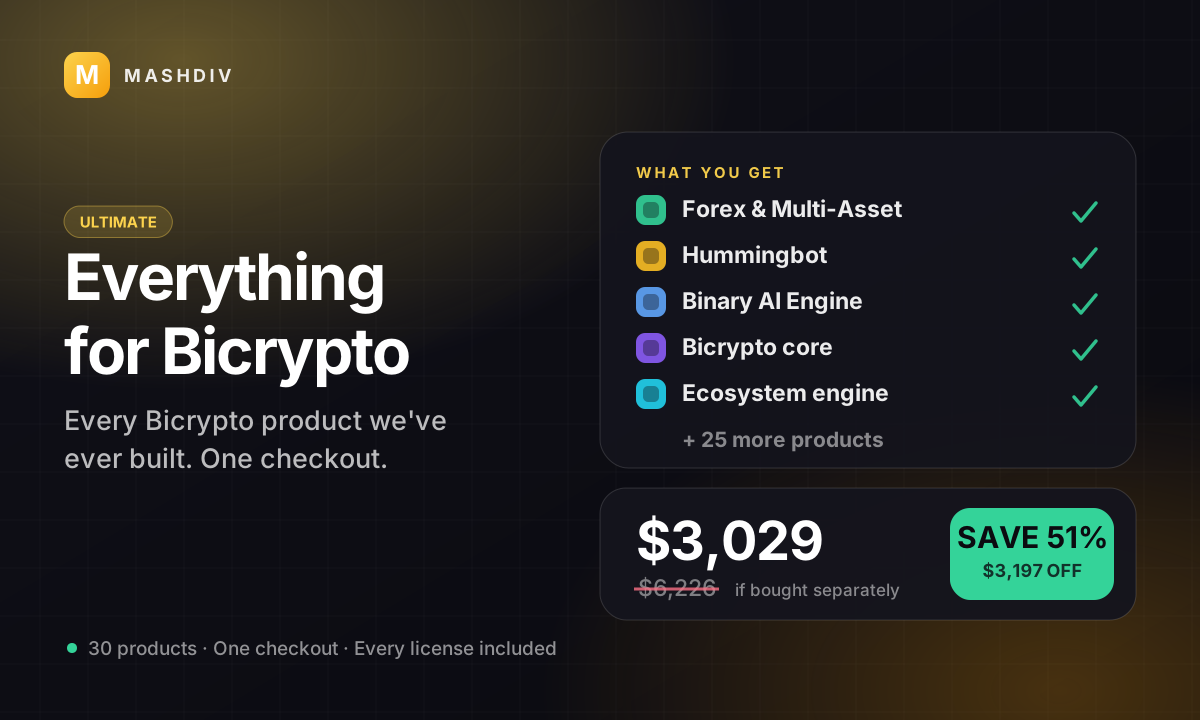
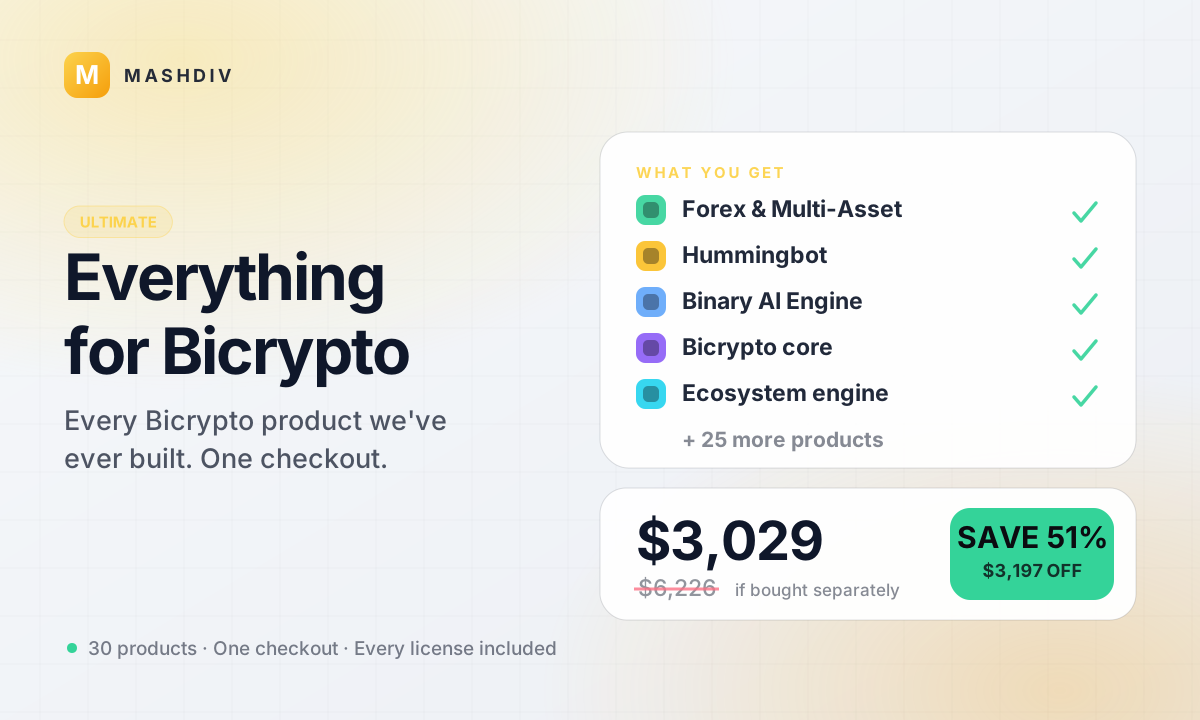 ULTIMATE
Everything for Bicrypto
Every Bicrypto product we make — every addon, every chain, both apps, one price.
- Forex & Multi-Asset Trading
- Hummingbot Connector
- Binary Trading AI Engine for Bicrypto
- Bicrypto
- + 27 more
Keep exploring
Related products
 Provider
KuCoin Exchange Provider
Back your spot desk with your own KuCoin account: markets, balances, deposits and payouts, one connection.
 Provider
Binance Exchange Provider
Point the whole spot desk at your own Binance account — real books and real prices, with no node to run.
 Provider
XT Exchange Provider
Run your platform's whole spot desk off your own XT account — one licence, one switch, one credential pair.